The Robot Report

  • Home
  • News
  • Technologies
    • Batteries / Power Supplies
    • Cameras / Imaging / Vision
    • Controllers
    • End Effectors
    • Microprocessors / SoCs
    • Motion Control
    • Sensors
    • Soft Robotics
    • Software / Simulation
  • Development
    • Artificial Intelligence
    • Human Robot Interaction / Haptics
    • Mobility / Navigation
    • Research
  • Robots
    • AGVs
    • AMRs
    • Consumer
    • Collaborative Robots
    • Drones
    • Humanoids
    • Industrial
    • Self-Driving Vehicles
    • Unmanned Maritime Systems
  • Business
    • Financial
      • Investments
      • Mergers & Acquisitions
      • Earnings
    • Markets
      • Agriculture
      • Healthcare
      • Logistics
      • Manufacturing
      • Mining
      • Security
    • RBR50
      • RBR50 Winners 2025
      • RBR50 Winners 2024
      • RBR50 Winners 2023
      • RBR50 Winners 2022
      • RBR50 Winners 2021
  • Resources
    • Automated Warehouse Research Reports
    • Digital Issues
    • eBooks
    • Publications
      • Automated Warehouse
      • Collaborative Robotics Trends
    • Search Robotics Database
    • Videos
    • Webinars / Digital Events
  • Events
    • RoboBusiness
    • Robotics Summit & Expo
    • DeviceTalks
    • R&D 100
    • Robotics Weeks
  • Podcast
    • Episodes
  • Advertise
  • Subscribe

MIT CSAIL creates materials that can sense the way they move

By Brianna Wessling | August 13, 2022

programmable material

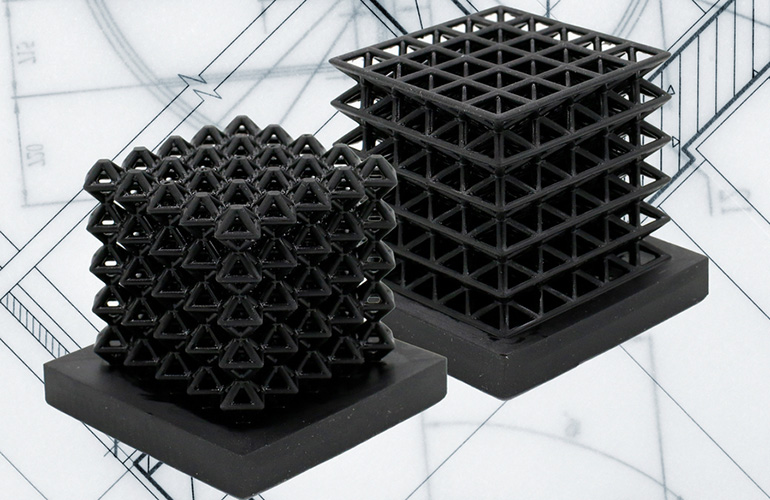
MIT researchers have created a 3D printed material with embedded sensors that can sense how its moving. | Source: MIT/CSAIL

Researchers at MIT’s Computer Science and Artificial Intelligence Laboratory (CSAIL) have developed programmable materials that can sense their own movements. The team created lattice materials with networks of air-filled channels, which allows researchers to measure changes in air pressure within the channels when the material is being moved or bent. 

The lattice structure created by the team is a kind of architected material, meaning when you change the geometry of the features in the material, its mechanical properties, like stiffness or toughness, are altered. For a lattice, the denser the network of cells making up the structure, the stiffer it is. 

It’s difficult to integrate sensors into these materials because of the sparse, complex shapes that make them up. Putting sensors outside the structure, however, doesn’t provide enough information to get a complete picture of how the material is deforming or moving. 

CSAIL’s team used digital light processing 3D printing to incorporate the air-filled channels into the struts that form the lattice structure of the team’s material. The researchers drew the structure out of a pool of resin and hardened it into a precise shape using projected light. In this method, an image is projected onto the wet resin, and areas struct by the light are cured. Researchers used pressurized air, a vacuum and intricate cleaning to remove any excess resin before it was cured.

When the resulting structure is moved or squeezed, the channels formed by the 3D printing are deformed, causing the volume of air inside to change. The team used an off-the-shelf pressure sensor to measure these changes in pressure and get feedback on how the material is deforming. 

The CSAIL team then built off of their results by building sensors into a class of materials developed for motorized soft robotics called handed shearing auxetics (HSAs). HSAs can be twisted or stretched, making them good for soft robotic actuators. Like architected materials, HSAs are difficult to embed sensors into because of their complex structure. 

The team ran the sensorized HSA material through a series of movements for over 18 hours, and used the sensor data they gathered to train a neural network to accurately predict the robot’s motion. 

In the future, the team hopes its technology could be used to create soft, flexible robots with embedded sensors. These robots could understand their own posture and movements. The CSAIL team also sees potential for their technology to be used to create wearable devices that provide feedback on how the user is moving or interacting with their environment. 

The team recently published the results of their study in Science Advances. Daniela Rus, the Andrew and Erna Viterbi Professor of Electrical Engineering and Computer Science and director of CSAIL, was the lead author on the paper. Co-authors included Lillian Chin, a graduate student at MIT CSAIL, Ryan Truby, former CSAIL postdoc and now assistant professor at Northwestern University, and Annan Zhang, CSAIL graduate student. 

About The Author

Brianna Wessling

Brianna Wessling is an Associate Editor, Robotics, WTWH Media. She joined WTWH Media in November 2021, after graduating from the University of Kansas with degrees in Journalism and English. She covers a wide range of robotics topics, but specializes in women in robotics, robotics in healthcare, and space robotics.

She can be reached at [email protected]

Tell Us What You Think! Cancel reply

This site uses Akismet to reduce spam. Learn how your comment data is processed.

Related Articles Read More >

Logos of sponsors MassRobotics, AWS, and NVIDIA. Applications are open for the second Physical AI Fellowship cohort.
MassRobotics expands physical AI fellowship with AWS and NVIDIA
A humanoid robot carrying a box in an automated facility.
Popular AI models aren’t ready to safely run robots, say CMU researchers
The FANUC LR Mate 200iD industrial robot arm, shown here, includes miniaturized components for agility.
How miniaturization is making robots smarter and more autonomous
An illustration of two Franka arms picking items in simulation.
PickNik expands support for Franka Research 3 robot on MoveIt Pro

RBR50 Innovation Awards

“rr
EXPAND YOUR KNOWLEDGE AND STAY CONNECTED
Get the latest info on technologies, tools and strategies for Robotics Professionals.

Latest Episode of The Robot Report Podcast

Automated Warehouse Research Reports

Sponsored Content

  • Supporting the future of medical robotics with smarter motor solutions
  • YUAN Unveils Next-Gen AI Robotics Powered by NVIDIA for Land, Sea & Air
  • ASMPT chooses Renishaw for high-quality motion control
  • Revolutionizing Manufacturing with Smart Factories
  • How to Set Up a Planetary Gear Motion with SOLIDWORKS
The Robot Report
  • Automated Warehouse
  • RoboBusiness Event
  • Robotics Summit & Expo
  • About The Robot Report
  • Subscribe
  • Contact Us

Copyright © 2025 WTWH Media LLC. All Rights Reserved. The material on this site may not be reproduced, distributed, transmitted, cached or otherwise used, except with the prior written permission of WTWH Media
Privacy Policy | Advertising | About Us

Search The Robot Report

  • Home
  • News
  • Technologies
    • Batteries / Power Supplies
    • Cameras / Imaging / Vision
    • Controllers
    • End Effectors
    • Microprocessors / SoCs
    • Motion Control
    • Sensors
    • Soft Robotics
    • Software / Simulation
  • Development
    • Artificial Intelligence
    • Human Robot Interaction / Haptics
    • Mobility / Navigation
    • Research
  • Robots
    • AGVs
    • AMRs
    • Consumer
    • Collaborative Robots
    • Drones
    • Humanoids
    • Industrial
    • Self-Driving Vehicles
    • Unmanned Maritime Systems
  • Business
    • Financial
      • Investments
      • Mergers & Acquisitions
      • Earnings
    • Markets
      • Agriculture
      • Healthcare
      • Logistics
      • Manufacturing
      • Mining
      • Security
    • RBR50
      • RBR50 Winners 2025
      • RBR50 Winners 2024
      • RBR50 Winners 2023
      • RBR50 Winners 2022
      • RBR50 Winners 2021
  • Resources
    • Automated Warehouse Research Reports
    • Digital Issues
    • eBooks
    • Publications
      • Automated Warehouse
      • Collaborative Robotics Trends
    • Search Robotics Database
    • Videos
    • Webinars / Digital Events
  • Events
    • RoboBusiness
    • Robotics Summit & Expo
    • DeviceTalks
    • R&D 100
    • Robotics Weeks
  • Podcast
    • Episodes
  • Advertise
  • Subscribe