Robotics Australia Group and HowToRobot are offering AI to help businesses get automation. Source: HowToRobot
Australia lags behind most other industrialized countries in terms of robot adoption, with a robot density of 134 robots per 10,000 manufacturing employees, according to the International Federation of Robotics, or IFR. The world average is 162. HowToRobot and Robotics Australia Group today said they are collaborating to accelerate the adoption of automation across Australian industry.
“Most businesses don’t yet have the structure, bandwidth, and expertise internally to move automation projects forward with the confidence and pace they need,” stated Søren Peters, founder and CEO of HowToRobot. “”We launched a new version of our platform, where AI is helping companies describe their projects. Instead of hiring an engineer to spend 18 months, they can use it to mature the project description so you can go to your manager and say, ‘Look, I need $200,000 to automate this.'”
“We did reports about different markets, and we kept in contact with a lot of these countries and their robot associations,” he told The Robot Report. “Like many other countries, Australia is struggling to get manufacturers to adopt automation. We showed its association the new version of HowToRobot, and it said, ‘Can we get a copy?’ We created a country version.”
HowToRobot said its independent validation system for automation helps companies work out what to automate, what it should cost, and who can deliver. The company said both small operations and Fortune 500 companies use its platform and network of experts to discover automation opportunities, specify projects, and connect with vetted suppliers from a global network.
Manufacturers in Australia need more automation
Australian manufacturing faces persistent skilled workforce shortages, cost pressures, and the slowest productivity growth in 60 years, according to the Australian Bureau of Statistics. In its National Robotics Strategy, the country‘s government said that increasing the use of automation could add $170 billion to $600 billion per year to Australia’s gross domestic product by 2030. (The U.S. has had similar discussions around a national robotics strategy.)
“If we want the productivity benefits of automation, we need to make it easier for more Australian businesses to actually adopt it,” said Paul Mason, CEO of Robotics Australia Group. “That means helping companies make better decisions before they spend the money — finding the right opportunities, building a sound business case, and getting the right solution providers around the table.”
Why is Australia’s robot density so low?
“Much of it is structural,” Mason told The Robot Report. “Australia’s robot installations were historically concentrated in automotive, and when the last car plant closed in 2017, our installed supplier base, along with the ecosystem around it, was diminished.
“Fortunately, some of this capability was adopted by our booming food and beverage industry,” he added. “However, Australia’s real strength has been in solving industry problems with field robotics — mining, agriculture, and defense, for example.”
“The shape of the sector matters too,” said Mason. “Australian manufacturing is dominated by SMEs [small and midsize enterprises] running high-mix, low-volume production, which is harder to automate and which has the least in-house engineering capacity. So each company effectively starts from scratch.”
Robotics Australia Group is intended to facilitate the growth of a sustainable and internationally competitive Australian robotics industry. The organization connects developers, researchers, integrators, manufacturers, adopters, educators, investors and government across the robotics and automation ecosystem. It has produced three editions of the “Australian Robotics Roadmap” and supported the National Robotics Strategy.
Editor’s note: Reshoring production with automation and field robotics will be among the topics discussed at RoboBusiness 2026, which will be on Oct. 20 and 21 in Santa Clara, Calif. Register now to attend.
 Register now and help us celebrate 20 years of RoboBusiness!
AutomationFinder.com.au is a national resource
The partners have launched AutomationFinder.com.au, a localized site operated by Robotics Australia Group and using HowToRobot’s AI. It is designed to help Australian businesses identify where automation could benefit their operations the most.
The subscription-based platform provides a structured system for local engineers to describe their needs and then them into supplier-ready project briefs, said HowToRobot. Users can then get real market feedback on costs, feasibility, and solution concepts from a global network of more than 20,000 vetted suppliers — including 500 in Australia alone.
AutomationFinder.com.au draws on data from more than 600 existing automation projects worldwide. The partners also said a panel of independent automation experts is available for hands-on engagements across Australia.
Australian companies can use the platform to compare suppliers, move forward with firm quotes, and make final selections. HowToRobot asserted that its system is vendor-neutral, relying on a mix of suppliers, from divisions of global vendors such as FANUC to local integrators and startups.
“What we see across the businesses already using our platform is that giving them a structured way to validate key decisions – what to automate, what it should cost, who can deliver it – is what makes adoption move faster and outcomes more predictable,” said Peters.
Mason added: “The practical effect is compressing a process that currently takes a year or more into weeks, with more than one credible option on the table and a realistic price benchmark behind it. It also lowers the risk on that critical first project, which is what determines whether a manufacturer keeps going.”
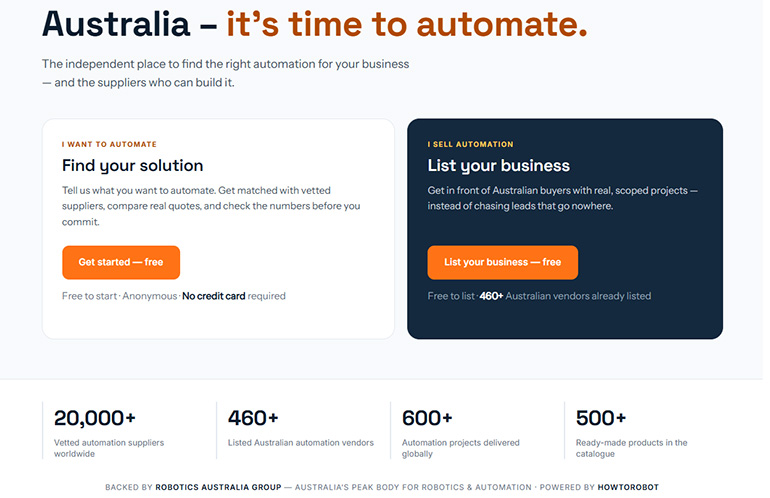
AutomationFinder.com.au is the first national version of the AI robotics sourcing platform. Source: HowToRobot
Australia minds the talent gap
While Australia has retained its research prowess and field robotics expertise, there is still a gap in talent, acknowledged Mason. HowToRobot can help companies in the meantime.
“The gap is further down: robot programmers, controls engineers, and integration and field-service technicians,” he said. “Vocational training in automation is fragmented, so companies either train on the job or compete for the same small pool of experienced people.”
“There is real interest in fixing it, but training capacity takes years to build, and manufacturers need to automate now,” asserted Mason. “That is part of the appeal of a platform model: Companies get access to suppliers and advisors who already have the expertise, so a first project does not depend on hiring a robotics team that does not exist yet. The demand this creates is also what makes the case for expanding training.”
First national platform for automation buyers, suppliers
AutomationFinder.com.au is the first country-wide licensed deployment of HowToRobot’s platform, but it won’t be the last, Peters said.
“We’re now getting contacted by other associations and countries. Every client is looking to shorten their supply chain,” he observed. “We’ve seen a lot of government initiatives spend enormous amounts of money and identify good things, but then they go nowhere. Even if one project goes forward, what about the other 11?”
“With HowToRobot, the platform remembers that, even if robotic palletizing is the thing that moves forward, you can go back to a company four months later and ask about packaging,” said Peters. “You get that memory in a sense.”
“Imagine that we had 10,000 companies in Australia that have all bookmarked what they are thinking, automation-wise, and you now give that information — anonymized, obviously — to the Australian people and say, ‘This is what you’re thinking of as a nation right now,'” he said. “That would really really change the the focus on what a country is trying to get moving.”
Where is the demand in Australia?
“Demand skews practical: palletizing and end-of-line packaging, machine tending, welding, vision-guided pick and place, and mobile robots for internal logistics,” replied Mason. “Welding is a standout given Australia’s well-documented welder shortage. Because so much production here is high-mix, the appetite is for flexible, re-deployable systems — cobots, standard cells, ready-made solutions — rather than hard-tooled lines.”
Trust is important to helping automation scale, according to Peters.
“It took us a while to understand our role — mom and pop shops are trying to find an accessible way of automating,” he acknowledged. “We don’t fly anyone to Ohio or California or wherever; we see if we can find a local guy. That’s important for building trust between buyers and sellers.”
“We’re not trying to take an advisory role — we providing the infrastructure piece,” said Peters. “People think we’re just a marketplace, but we’re helping to build a pipeline for the discovery and buying part of robotics.”



Tell Us What You Think!