The Robot Report

  • Home
  • News
  • Technologies
    • Batteries / Power Supplies
    • Cameras / Imaging / Vision
    • Controllers
    • End Effectors
    • Microprocessors / SoCs
    • Motion Control
    • Sensors
    • Soft Robotics
    • Software / Simulation
  • Development
    • Artificial Intelligence
    • Human Robot Interaction / Haptics
    • Mobility / Navigation
    • Research
  • Robots
    • AGVs
    • AMRs
    • Consumer
    • Collaborative Robots
    • Drones
    • Humanoids
    • Industrial
    • Self-Driving Vehicles
    • Unmanned Maritime Systems
  • Business
    • Financial
      • Investments
      • Mergers & Acquisitions
      • Earnings
    • Markets
      • Agriculture
      • Healthcare
      • Logistics
      • Manufacturing
      • Mining
      • Security
    • RBR50
      • RBR50 Winners 2025
      • RBR50 Winners 2024
      • RBR50 Winners 2023
      • RBR50 Winners 2022
      • RBR50 Winners 2021
  • Resources
    • Automated Warehouse Research Reports
    • Digital Issues
    • eBooks
    • Publications
      • Automated Warehouse
      • Collaborative Robotics Trends
    • Search Robotics Database
    • Videos
    • Webinars / Digital Events
  • Events
    • RoboBusiness
    • Robotics Summit & Expo
    • DeviceTalks
    • R&D 100
    • Robotics Weeks
  • Podcast
    • Episodes
  • Advertise
  • Subscribe

Crewline secures $7.1M to automate construction’s most repetitive task

By Mike Oitzman | April 22, 2026

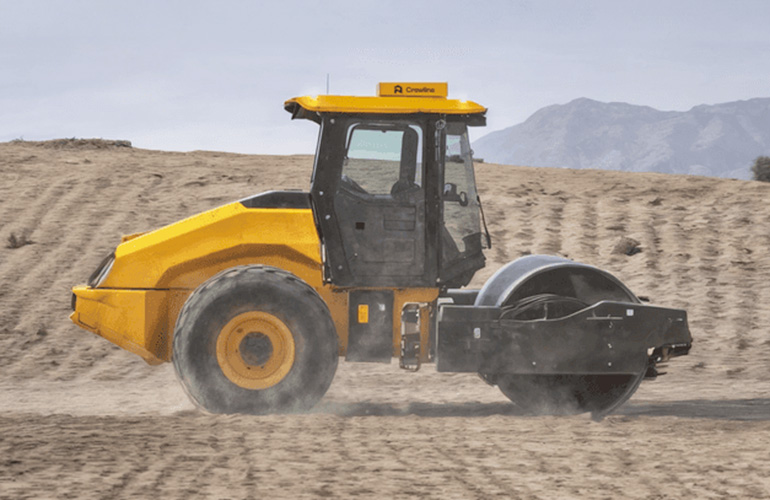
hero image of a compactor on a dirt road with no operator in the cab.

Crewline has developed an autonomy solution for soil compactors that can be installed in an hour, providing a self-driving capability. | Source: Crewline

Addressing a structural labor crisis that forces contractors to cancel nearly two-thirds of their jobs, San Francisco startup Crewline has secured a $7.1 million seed round to deploy an autonomous retrofit kit for construction rollers. By transforming the jobsite’s most repetitive and least-desired task into a self-driving operation, the company is leveraging a “wedge” strategy to tackle a workforce shortage of nearly 500,000 workers. It has already amassed a $26 million waitlist of contractors eager to scale productivity without adding headcount.

CEO and co-founder Frederik Filz-Reiterdank leads a lean four-person team, including, cofounder and CTO, Mohamed Sadek that is developing the new construction automation solution. Already on version six, the company is shipping a new kit revision roughly every 3 weeks.

Filz-Reiterdank told The Robot Report that “labor availability is the #1 constraint on the industry. Ninety-two percent of contractors say they can’t fill open positions (AGC’s 2025 workforce survey). Forty-five percent have delayed projects specifically because of worker shortages. AGC estimates the industry needs ~499,000 net new workers in 2026 and roughly 1.9 million over the next decade. It’s structural, not cyclical – the construction unemployment rate is 3.5%, meaning there’s essentially nobody with experience looking for a job. Contractors already believe automation is part of the answer: 45% expect robotics and AI to positively impact construction jobs, up from 41% in 2024.”

Low-hanging fruit in road construction

Compaction is key to every earth-moving project. Driving a compactor is also the lowest-skilled job. Similar to the tillage workflow in agriculture, compaction is repetitive and pattern-based. There’s nothing to replenish (other than fuel), and nothing to load or unload. Unlike excavation, you can’t hit a utility with a compactor. The key technical problem with compaction is avoiding obstacles like vehicles and crew; otherwise, it’s a basic line-following algorithm.

Crewline’s core principle is that most robotics companies die iterating on hardware and software simultaneously. “We avoided that by retrofitting an existing machine rather than building one. Our kit goes on a standard roller in an hour, no wire cutting, fully reversible,” said Filz-Reiterdank. “Second, soil compaction is the most automatable earthwork task. It’s pattern-based (cover the area N times at a given overlap), forgiving of error, and doesn’t require the sub-centimeter blade control that grading does.”

According to Filz-Reiterdank, “ROI is the core of the economic model. The roller runs fully autonomously. A single human (on a dozer, motor grader, or as a site foreman) sets the roller’s mission from an iPad in under a minute: draws the zone on a map, hits go. The roller then runs on its own for hours with onboard obstacle and crew detection. So one operator who was previously running one machine can now supervise one machine plus one or more rollers. That’s labor multiplication, not labor replacement, which is what makes the ROI work at current wage levels. Watts Services is scaling from one of our rollers to three on that basis.”

A pragmatic approach to autonomy

While compaction is the first construction workflow on its roadmap, Crewline is working on excavation and grading workflows.

The roadmap, as described by Filz-Reiterdank, is straightforward: first, retrofit existing machines instead of designing new ones from scratch. This is a strategy currently used by most heavy equipment automation companies, so it’s well-founded.

Next, the company is deploying immediately on real job sites. Working with partners like Watts Services and DSS, the company has also built a list of 200+ prospects since ConExpo. This has enabled the company to generate revenue from day one while continuously collecting real-world data.

The result is fast iteration and hardening of the solution.

The tech stack

The tech stack employed by Crewline leverages a handful of industry-leading technologies for autonomous vehicles and heavy equipment autonomy.

  • Compute: Rugged NVIDIA Jetson onboard.
  • Perception: Stereo cameras for 360° coverage, used for crew, vehicle, and obstacle detection. Relying on vision language AI models.
  • Positioning: Dual RTK-GPS for accurate positioning.
  • Connectivity: Starlink for coverage in remote locations.
  • Safety: Dedicated safety controller, two wireless e-stops.
  • Actuation: Drive-by-wire via integration with the machine’s existing controls. No permanent modifications, reversible in under an hour.

SITE AD for the 2026 RoboBusiness call for speakersRegister now and help us celebrate 20 years of RoboBusiness!

About The Author

Mike Oitzman

Mike Oitzman is a robotics industry veteran and Senior Editor of WTWH Media’s Robotics Group, covering automation for The Robot Report and co-hosting its podcast. With 25+ years of experience, including leadership roles at Adept Technology, Mike founded the Mobile Robot Guide (acquired by WTWH). He is a leading expert on Autonomous Mobile Robots (AMRs), physical AI, and RaaS business models, holding a Systems Engineering degree and an MBA. He can be reached at [email protected].

Tell Us What You Think! Cancel reply

This site uses Akismet to reduce spam. Learn how your comment data is processed.

Related Articles Read More >

A robot arm palletizing packages.
Closing the reality gap: Why real-time execution has become the new competitive advantage
Boston Dynamics' Atlas humanoid robot doing a cartwheel.
Will ‘boring’ robots win in the real world? Why robotic form should follow workflow
Nicolas Sauvage, the founder and president of TDK Ventures, with ANYbotics' quadruped robot.
Why dexterity is physical AI’s real bottleneck
Headshot of Jeanine Sinanan-Singh and podcast logo.
Why humanoid robot demos still fail the generalization test

RBR50 Innovation Awards

“2026”
“rr
EXPAND YOUR KNOWLEDGE AND STAY CONNECTED
Get the latest info on technologies, tools and strategies for Robotics Professionals.

Latest Episode of The Robot Report Podcast

Automated Warehouse Research Reports

Sponsored Content

  • Precision In Motion. Vishay Precision Group, Inc. (VPG) to Showcase Custom Sensing Capabilities for Humanoid Robotics at RoboBusiness 2026
  • Your Robot’s Safety Functions Already Work. What If the Input Lies?
  • Designing long-travel axes: When rack and pinion outperforms ball screws and linear motors
  • How to select the right rack and pinion system for high-precision linear motion
  • The Missing Layer in Robot Safety Assurance
More Sponsored Content >
The Robot Report
  • Automated Warehouse
  • RoboBusiness
  • Robotics Summit & Expo
  • About The Robot Report
  • Subscribe
  • Contact Us

Copyright © 2026 Arrowfly LLC. All Rights Reserved. The material on this site may not be reproduced, distributed, transmitted, cached or otherwise used, except with the prior written permission of Arrowfly
Privacy Policy | Advertising | About Us

Search The Robot Report

  • Home
  • News
  • Technologies
    • Batteries / Power Supplies
    • Cameras / Imaging / Vision
    • Controllers
    • End Effectors
    • Microprocessors / SoCs
    • Motion Control
    • Sensors
    • Soft Robotics
    • Software / Simulation
  • Development
    • Artificial Intelligence
    • Human Robot Interaction / Haptics
    • Mobility / Navigation
    • Research
  • Robots
    • AGVs
    • AMRs
    • Consumer
    • Collaborative Robots
    • Drones
    • Humanoids
    • Industrial
    • Self-Driving Vehicles
    • Unmanned Maritime Systems
  • Business
    • Financial
      • Investments
      • Mergers & Acquisitions
      • Earnings
    • Markets
      • Agriculture
      • Healthcare
      • Logistics
      • Manufacturing
      • Mining
      • Security
    • RBR50
      • RBR50 Winners 2025
      • RBR50 Winners 2024
      • RBR50 Winners 2023
      • RBR50 Winners 2022
      • RBR50 Winners 2021
  • Resources
    • Automated Warehouse Research Reports
    • Digital Issues
    • eBooks
    • Publications
      • Automated Warehouse
      • Collaborative Robotics Trends
    • Search Robotics Database
    • Videos
    • Webinars / Digital Events
  • Events
    • RoboBusiness
    • Robotics Summit & Expo
    • DeviceTalks
    • R&D 100
    • Robotics Weeks
  • Podcast
    • Episodes
  • Advertise
  • Subscribe