The Robot Report

  • Home
  • News
  • Technologies
    • Batteries / Power Supplies
    • Cameras / Imaging / Vision
    • Controllers
    • End Effectors
    • Microprocessors / SoCs
    • Motion Control
    • Sensors
    • Soft Robotics
    • Software / Simulation
  • Development
    • Artificial Intelligence
    • Human Robot Interaction / Haptics
    • Mobility / Navigation
    • Research
  • Robots
    • AGVs
    • AMRs
    • Consumer
    • Collaborative Robots
    • Drones
    • Humanoids
    • Industrial
    • Self-Driving Vehicles
    • Unmanned Maritime Systems
  • Business
    • Financial
      • Investments
      • Mergers & Acquisitions
      • Earnings
    • Markets
      • Agriculture
      • Healthcare
      • Logistics
      • Manufacturing
      • Mining
      • Security
    • RBR50
      • RBR50 Winners 2025
      • RBR50 Winners 2024
      • RBR50 Winners 2023
      • RBR50 Winners 2022
      • RBR50 Winners 2021
  • Resources
    • Automated Warehouse Research Reports
    • Digital Issues
    • eBooks
    • Publications
      • Automated Warehouse
      • Collaborative Robotics Trends
    • Search Robotics Database
    • Videos
    • Webinars / Digital Events
  • Events
    • Robotics Summit & Expo West
    • Robotics Summit & Expo
    • DeviceTalks
    • R&D 100
    • Robotics Weeks
  • Podcast
    • Episodes
  • Advertisers
    • Advertise
    • PR Submissions
    • Eblast Submissions
  • Subscribe

ABB transforms AMR performance with launch of Visual SLAM technology

By Mike Oitzman | April 25, 2023

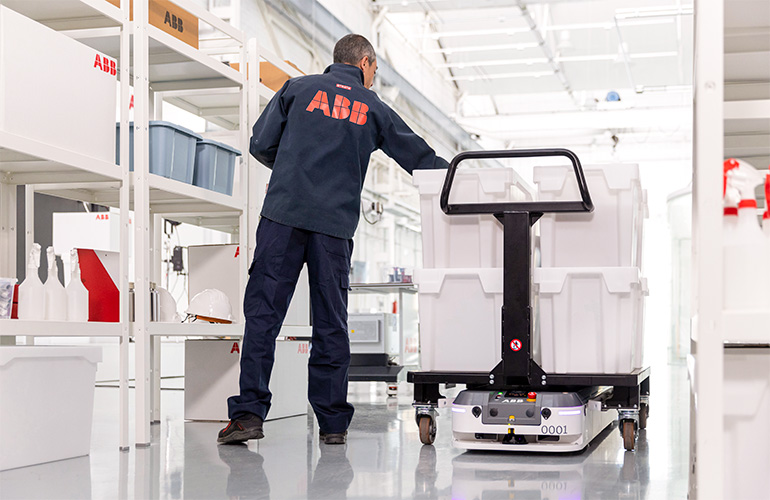
a human loads boxes onto an ABB AMR.

Visual SLAM enables AMRs to navigate effectively in complex working environments. | Credit:ABB

ABB Robotics is adding Visual Simultaneous Localization and Mapping (VSLAM) technology to its Autonomous Mobile Robots (AMRs). This enables ABB AMRs to make intelligent path-planning and obstacle-avoidance decisions based on their surroundings. 

VSLAM uses AI algorithms together with the data from 3D vision cameras to perceive the world around the AMR in a three-dimensional representation. VSLAM has many benefits over other ways of navigating, like magnetic tape or QR codes which need more infrastructure to function properly. SLAM-based navigation techniques reduce commissioning time by up to 20 percent, requiring less calibration and no change to infrastructure.

Compared to 2D SLAM technology, VSLAM creates a three-dimensional view of the world. This ensures that the AMR can see overhangs such as shelving, drawers, walkways, cables, fork truck forks and other obstacles that are above ground level. Without this information, or additional onboard sensors, a 2D SLAM-based AMR might crash into these types of obstacles.

closeup image of the front of an ABB AMR with new stereo vision cameras.

This close-up shows the front-facing location of new 3D vision cameras that are used for image capture of the environment in front of the vehicle. | Credit: ABB

2D SLAM is the current state of the art for AMR perception today. AMRs that leverage a 2D LiDAR perceive a 2D “slice” of the environment surrounding the AMR, typically at a height somewhere between 2” to 12” (50 mm to 305 mm) above ground level (the location of the LiDAR sensor).

“Our introduction of Visual SLAM AMRs radically enhances companies’ operations, making them faster, more efficient and more flexible, while freeing up employees to take on more rewarding work,” said Marc Segura, President of ABB Robotics Division. “Offering more autonomy and intelligence, our new AMRs operate safely in dynamic, human-populated environments. Visual SLAM technology provides a new level of intelligence for AMRs that transforms robotic applications, from production and distribution through to healthcare.”

VSLAM creates a real-time 3D map of all nearby objects and the perception algorithms provide a similar understanding to how human eyes perceive the world. VSLAM-based AMRs can see the floor, walls, and ceiling. It can also distinguish objects like humans, support beams, conveyors, fork trucks and even other AMRs. The solutions are capable of providing 0.1” (3 mm) accuracy.

Vision cameras are also much less expensive than rotating mirror LiDAR sensors, which helps reduce the overall cost of the AMR. The cameras have no moving parts, which also makes them more robust than a LiDAR unit, especially for a moving platform like an AMR that experiences vibrational shock from every crack and seam in the building’s concrete floor.

A downside of using 3D VSLAM over 2D SLAM, however, is that the perception algorithms are more computationally intensive, which means that the system requires more powerful edge computing onboard, and typically requires more power consumption. Battery management and utilization are of critical importance to a battery-powered mobile device like an AMR. But the benefits of improved perception performance outweigh any increased battery consumption for most ground-based mobile robots.

ABB developed Visual SLAM AMRs in collaboration with partner Sevensense Robotics, a provider of AI and 3D visualization technology. ABB’s latest AMRs, the AMR T702V, and AMR P604V, will implement the technology in Q3 and Q4 2023 respectively. More VSLAM-based AMR solutions from ABB will follow until 2025.

ABB acquired ASTI Mobile Robotics in July 2021, paying $190 million for the Spanish company. The ASTI headquarters is now the worldwide development center for ABB’s mobile robotics division. We talked to Sami Atiya, CEO of ABB Robotics and Verónica Pascual, CEO of ASTI Mobile Robotics to get their insights on the acquisition in episode 48 of The Robot Report Podcast.

About The Author

Mike Oitzman

Mike Oitzman is a robotics industry veteran and Senior Editor of WTWH Media’s Robotics Group, covering automation for The Robot Report and co-hosting its podcast. With 25+ years of experience, including leadership roles at Adept Technology, Mike founded the Mobile Robot Guide (acquired by WTWH). He is a leading expert on Autonomous Mobile Robots (AMRs), physical AI, and RaaS business models, holding a Systems Engineering degree and an MBA. He can be reached at [email protected].

Comments

  1. Isaac says

    July 30, 2024 at 10:10 pm

    What programming language, software stack, framework is the robot programmed on

    Reply

Tell Us What You Think! Cancel reply

This site uses Akismet to reduce spam. Learn how your comment data is processed.

Related Articles Read More >

Two robot arms folding a cardboard box.
How Rhoda AI is using video data to create generalized AI models for robots
Narwal has designed robots that can both vacuum and mop.
Narwal builds robot vacuums to serve regional needs
NVIDIA headquarters in Santa Clara, Calif.
NVIDIA replaces CEO amid China AI and robotics concerns
The Viam Launchpad Robotics Lab in New York.
Viam Launchpad aims to accelerate robotics deployments

RBR50 Innovation Awards

“2026”
“rr
EXPAND YOUR KNOWLEDGE AND STAY CONNECTED
Get the latest info on technologies, tools and strategies for Robotics Professionals.

Latest Episode of The Robot Report Podcast

Automated Warehouse Research Reports

Sponsored Content

  • Six AGIBOT G2 Robots Complete 1,730 Tasks in 24-Hour Shanghai Convenience Store Trial
  • LiberAI Unveils Liber-0, a World Action Model That Grounds Human Experience in Robot Action
  • 28 Zero-Day Findings in Less Than Two Days: What AI-Speed Discovery Means for Robotics
  • Solving the Interconnect Challenge in Modern Robotics: How 3M Is Engineering for Motion, Density, and Uptime
  • WorldOracle Tests Whether World Models Can Reliably Predict Real-World Executions
More Sponsored Content >
The Robot Report
  • Automated Warehouse
  • Robotics Summit & Expo West
  • Robotics Summit & Expo
  • About The Robot Report
  • Subscribe
  • Contact Us

Copyright © 2026 Arrowfly LLC. All Rights Reserved. The material on this site may not be reproduced, distributed, transmitted, cached or otherwise used, except with the prior written permission of Arrowfly
Privacy Policy | Advertising | About Us

Search The Robot Report

  • Home
  • News
  • Technologies
    • Batteries / Power Supplies
    • Cameras / Imaging / Vision
    • Controllers
    • End Effectors
    • Microprocessors / SoCs
    • Motion Control
    • Sensors
    • Soft Robotics
    • Software / Simulation
  • Development
    • Artificial Intelligence
    • Human Robot Interaction / Haptics
    • Mobility / Navigation
    • Research
  • Robots
    • AGVs
    • AMRs
    • Consumer
    • Collaborative Robots
    • Drones
    • Humanoids
    • Industrial
    • Self-Driving Vehicles
    • Unmanned Maritime Systems
  • Business
    • Financial
      • Investments
      • Mergers & Acquisitions
      • Earnings
    • Markets
      • Agriculture
      • Healthcare
      • Logistics
      • Manufacturing
      • Mining
      • Security
    • RBR50
      • RBR50 Winners 2025
      • RBR50 Winners 2024
      • RBR50 Winners 2023
      • RBR50 Winners 2022
      • RBR50 Winners 2021
  • Resources
    • Automated Warehouse Research Reports
    • Digital Issues
    • eBooks
    • Publications
      • Automated Warehouse
      • Collaborative Robotics Trends
    • Search Robotics Database
    • Videos
    • Webinars / Digital Events
  • Events
    • Robotics Summit & Expo West
    • Robotics Summit & Expo
    • DeviceTalks
    • R&D 100
    • Robotics Weeks
  • Podcast
    • Episodes
  • Advertisers
    • Advertise
    • PR Submissions
    • Eblast Submissions
  • Subscribe